

Reasonable Adjustments, SocAIl Equity and the maths your lawyers won't do (yet)
The same gaps that make us rely on social equity and the occasional enable-neighbour are baked into our infrastructure, systems and AI. Numbers, frameworks and consequences.

A long time ago and in a galaxy far, far away… well the late ‘80s and the Sunday Times… I read a piece on social equity. The idea was simple, social equity is an alternative to money. I liked the idea much better. Developing value through the way I dealt with others felt more authentic and a better way to live (interesting since I was a temp accountancy work throughout every school holiday).
I’ve considered my worth through a social equity lens since. It combines well with my social conscience and what I now know to be good old ADHD-related heightened empathetic sensitivity. Gen Z calls it ‘aura points’. However described, social equity doesn’t pay the bills, but really smooths the way. Help when you can, without counting. It comes back to you. Neighbours help when you need them, local businesses are happy to give credit, you feel good about your place in the world. So much more.
I recently found myself in a upsetting situation where my lawyers’ ideas of ‘reasonable adjustments’ were less effective than Boris Johnson’s idea of birth control. I realised it was unrealistic to expect them to meet adjustments I hadn’t articulated myself, so I did some basic desk research and came up with some actual figures.
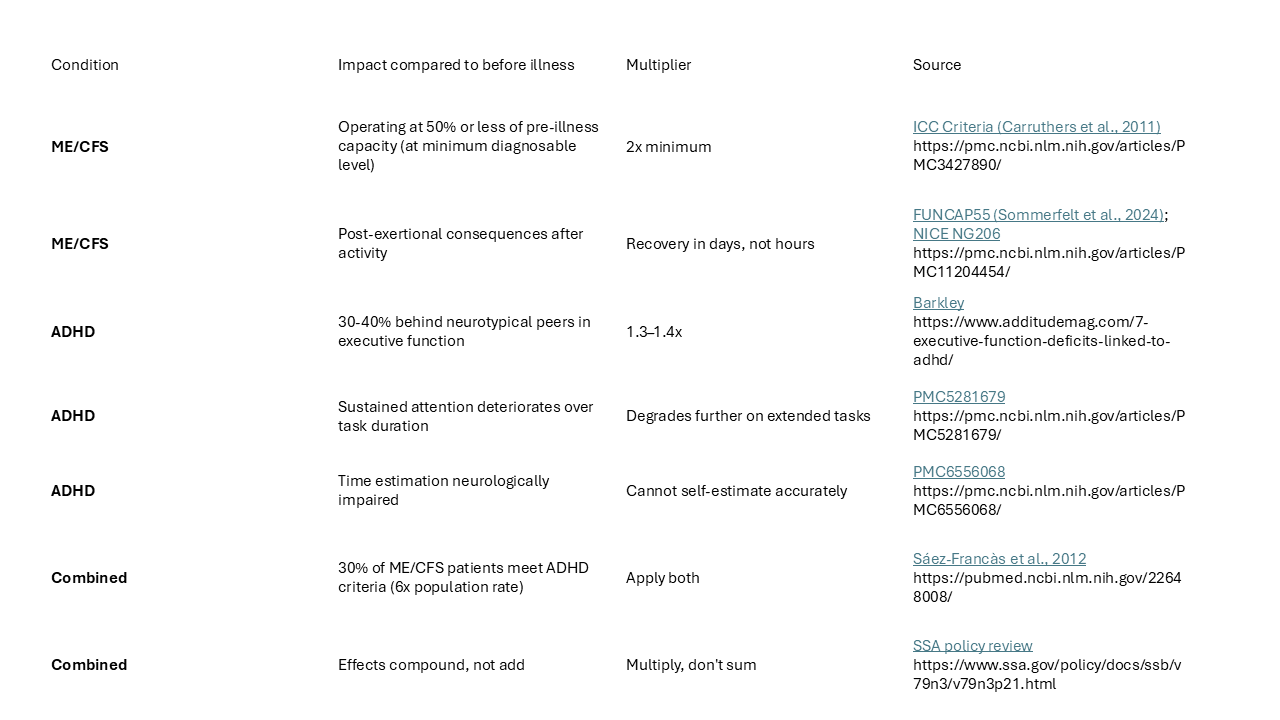
I can’t find formal guidance, but the table above contains actual, conservative, evidence-based figures. Minimum figures. Figures from papers that are peer-reviewed and cited. Figures that have taken the mildest case that qualifies. These figures compound. The ignores that I’ve lost 36 people in just under 6 years because I couldn’t find anything reputable on that.
The absence of any quantative consideration from official frameworks is not a gap waiting to be filled. It’s a systemic, structural feature. Despite our current government’s commitment to the Social Model of Disability, the burden of proof – as ever – sits with disabled people. Such systemic gaps impact tens of thousands of us daily, and in this story to me.
You’re expecting me to say that AI systems fail disabled users the same way, aren’t you. That, trained on majority-population data, AIs miss the blindingly obvious. That nobody’s done the risk assessment on the long-tail edge cases everyone knows about, but rarely models (honestly, it’s not that hard). That the training data has the same gaps as legal frameworks (err… what have I set out other than initial specs? At least we’re beginning to see audits). That under-representing edge cases in fine-tuning creates an avoidable model risk (modelled). That people most likely to have un quantified needs, or those unable to articulate them, the people that formal systems are already failing, will be failed further. Right now, that is true.
Here’s the thing. These gaps don’t just hit disabled people. Redundancy. Sickness. Divorce. A parent with dementia. Uncontrollable migraines. A diagnosis you didn’t see coming… Sooner or later, most of us are felled by a combination of challenges that compound in ways we never imagined. A framework to defend from this isn’t hard to imagine. In some ways it’s creation would be easy and it’s not too late to build. If we don’t the consequences won’t just hit disabled people or those who you’ve labelled neurodivergent. We need accountability and proper governance. ISO/IEC 42001 as a floor, not a ceiling, and structured joined-up thinking. Without these, AI will also fail you.
I shared the funny bits of this story (yes there are some) with one of my neighbours this morning. I’m planning to write about it, but couldn’t find a way to do so without the piece feeling vindictive (after years of trying to embody ideas of social equity and inclusion, is neither my nature nor choice). She suggested writing to legal publications to give future lawyers a framework before someone else is forced to fight for one. I hadn’t thought of pitching that sort of journal. Her idea’s an embodiment of social equity. Like it says on the label, she’s an enable-neighbour, providing worthwhile returns.